
Polyamorous eroticism in the antebellum South pits white women's sexuality against purity culture while implicating readers in problematic racial power structures
[Erotic Literature] [Southern Literature] [Polyamory] [Race and Power] Anonymous.
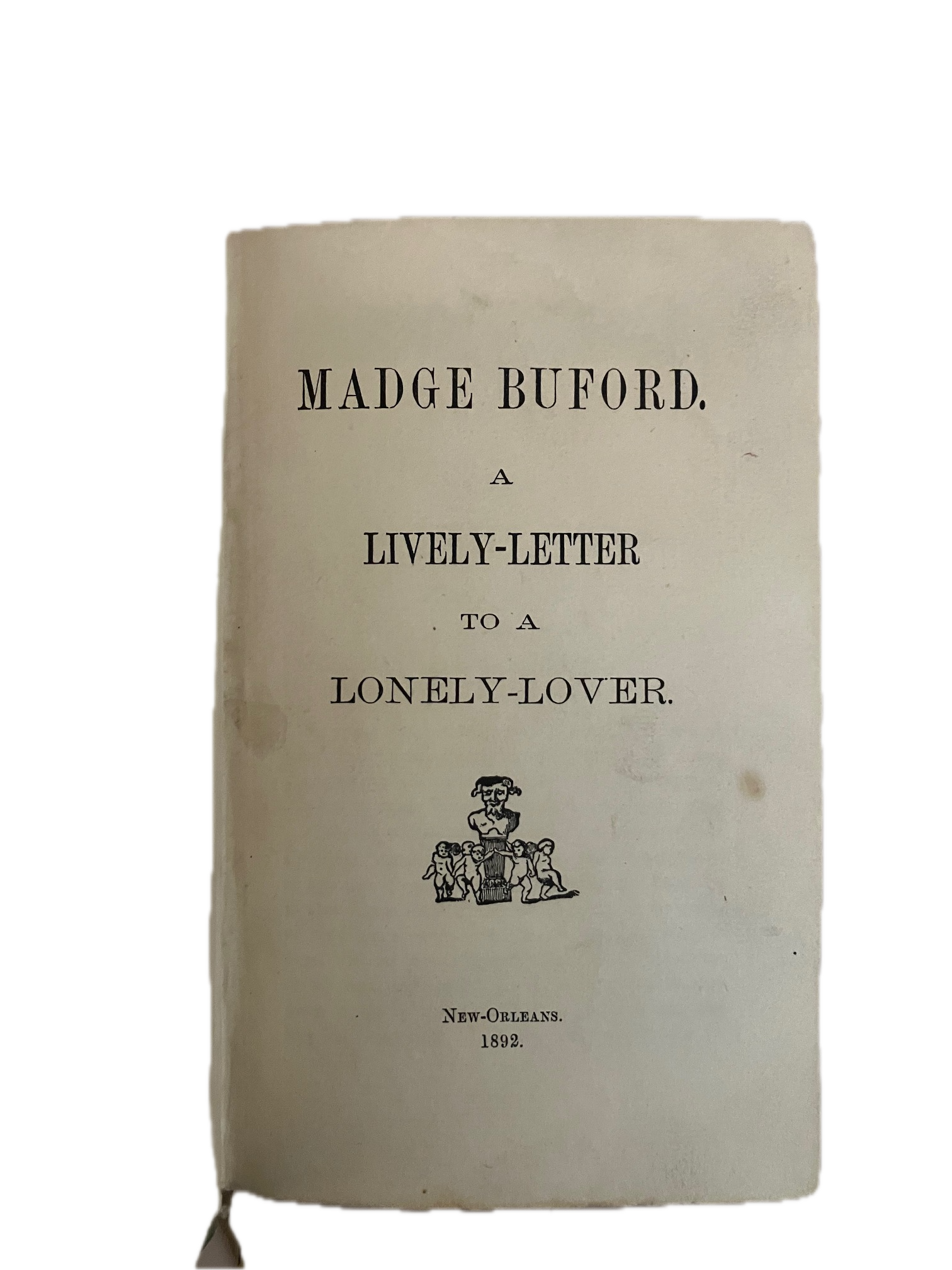
Madge Buford: A Lively-Letter to a Lonely-Lover.
Publisher's half cloth over marbled boards with gilt and morocco to spine. Measuring 165 x 100mm and collating complete including half title and rear catalogue of erotic texts: [4], 5-146, [6]. Early joint repairs resulting in excess glue adhering preliminary and end leaves to pastedowns along gutter. Occasional pen check-marks from an early reader and several marginal spots, with interior largely clean. Unrecorded by OCLC and no appearances in the modern auction record; the text is also unrecorded by the Register of Erotic Books despite its adverts containing several known titles. We have been unable to locate any other examples.
Often described, on the surface at least, as "a medium for expressing norms about male power and domination," and for responding to everday sexual repression, early erotic books form a complex and unstable genre that most often titillates by refusing to conform to expectation (Diamond). While the broader genre of the novel exploded in popularity during the 18th and 19th centuries, so too did this sub-genre. In a Victorian social space that demanded rigid performance, erotic books offered readers a chance to learn, fantasize, give into, and resist heteronormative guidelines that subverted pleasure in favor of procreation. Many of the erotic texts of the period emerged out of England and France, with significantly stricter publication guidelines preventing their widespread printing and distribution in the United States. Piracy and clandestine publishing were two common methods of production. Madge Buford is an example of these practices; it is unknown to date who produced the work, how many copies were published, and how or where they were sold. The advertising catalogue at the rear provides little clue, as the pornographic titles listed there come from a range of dates in the nineteeth century as well as from various publishers and countries.
What separates Madge Buford from other texts of its period is its Southern setting and its unabashed interactions with race and power. At its opening and closing pages, the novel reminds us that this is a "lively-letter to a lonely-lover" -- specifically, the titular Madge writing an elicit story to her lover Jack, who has departed the South to participate in the colonization of the West. The interior bulk of the text can easily distract readers from this structure. As Madge gives her lengthy and graphic narration of her sexual awakening on her family's plantation in Louisiana, the text obviously aims to excite its reader. But it also seems intent on creating discomfort.
For over a hundred pages, Madge describes without pause her lustful activities with her uncle, the mixed-race enslaved men and women working within the house, the Black peoples enslaved on the property, animals, and random visitors to the home. Throughout, the novel asks readers whether their ethical qualms will override their physical responses. In doing this, the text implicates the pornographic reader in structures of white dominance -- a supremacy that Madge fantasizes is accessible and liberating to women like her. After all, Madge may seem defiant for remaining behind on the plantation in her polycule comprised of her uncle John, mixed race and enslaved Sam and Meg (both of whom are implied to be her relatives), and her white husband Ralph. But the brief and important epistolary bookends are crucial in reminding us of Madge's larger project. These pieces of text make it inescapable that Madge's story-telling is designed to arouse Jack, a white male reader who has expressed frustration that there isn't "a c*nt within a hundred miles" and to encourage him to recognize the white supremacist colonialist possibilities of his surroundings: "If reading this works on you, as writing it has on me, all the Indian sq*ws on the plains will be giving birth to little Jack Gardiners." The wider eroticism of the text may undercut notions of procreation to emphasize wild, non-normative pleasures, and it may try to belie or even sexualize the racial power dynamics it sets before the reader; but the epistolary caps always confine the text to a more violent conservative purpose and draw us back to the racialized power imbalances within the text's core.
Victorian erotica, then, might be a miscategorization of Madge Buford. It could perhaps be more accurately described as an antebellum pornographic fantasy, published after emancipation and forming a connection between the white supremacy of enslavement and of Indigenous oppression. It deserves further research for its handling of white supremacy, white feminism, incestuous interactions both consensual and non-consensual in plantation spaces, consent and coercion, and racial stereotyping just as much as for its depiction of white female sexuality existing in opposition to Victorian and Southern purity culture.
Not in the Register of Erotic Books. (391)