
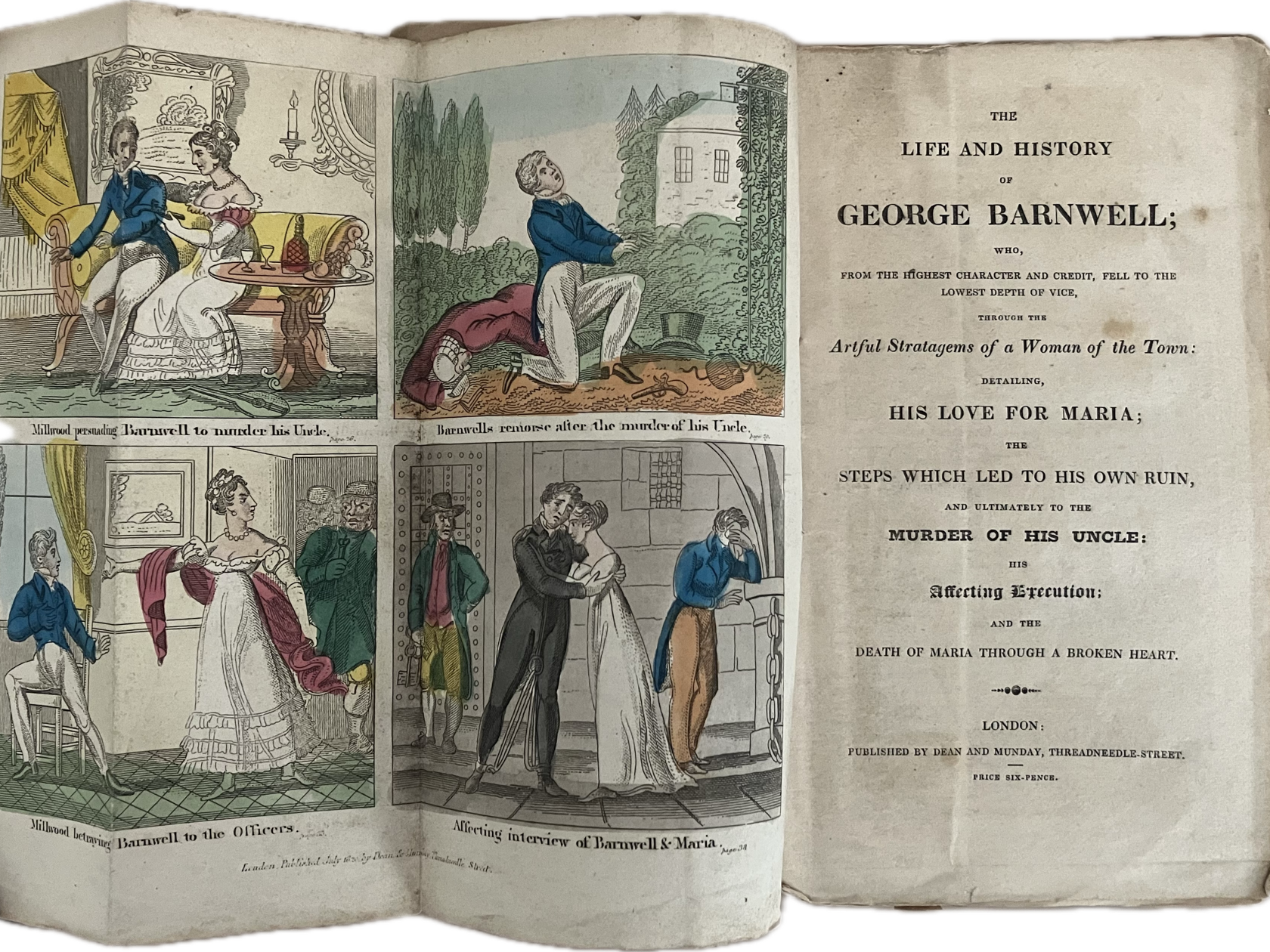
A chapbook corresponding to the rise and fall of courtesan culture seeks to satisfy three target audiences: those seeking melodrama, those seeking light erotica, and those craving just-deserts
[Sex Workers] [Erotic Literature] [Working Class Literature]
The Life and History of George Barnwell, who, from the highest character and credit, fell to the lowest pitch of vice, through the artful strategems of a woman of the town…
London: Dean & Munday, ThreadNeedle Street, [1820]. First Edition. Original printed wraps stitched at spine as issued. Measuring 185 x 110mm and collating complete in 34 pages including hand-colored folding plate at front. Spine largely perished and front wrap trimmed short along the outer margin but binding sound; wraps and textblock generally chipped and worn at margins with no text affected. Light toning throughout. A delicate, unsophisticated survivor of this popular adaptation of T. S. Surr's The London Merchant: or, The History of George Barnwell a Tragedy (1731), OCLC reports only three copies at libraries. It has appeared once at auction, in 1941, and the present is the only first edition example in trade.
A popular narrative originating in the 17th century, the story of George Barnwell reached the height of its fame in the 18th and 19th centuries alongside that of demi-monde culture. Transformed into a theatrical in the 18th century, the 19th century saw its reemergence in the present chapbook form. The cheap and easily accessible medium was appealing to a wide readership, and The Life and History of George Barnwell attracted audiences who wanted sensational melodrama, those who desired erotic titillation, and readers who craved a didactic lesson and the satisfaction of punishment for sinners. The lengthy title provided by publishers Dean & Munday left no doubt for potential purchasers that their desires -- whatever they might be -- would be satisfied by their sixpence acquisition. Further editions would be released through the 1840s.
There is little doubt that this version of George Barnwell supported the downfall of the celebrity courtesan and her affiliated successful female bawds. Indeed, the text suggests that these women's success was not only made on their backs, but off the backs of working class men whose mobility was hindered through their fees. Representing that contingent is the heartless Sarah Milwood, "the daughter of a respectable merchant in Bristol, who spared no expense in endowing her with every accomplishment." Sarah's betrayal of her father by eloping with his hairdresser, living unmarried for a time, and then "converting her house into a brothel" upon her lover's death reflect in some sense the histories of several famous women of the sex trade. When she sets her sights upon George Barnwell, she does so believing he's a man with greater fortune than he is -- having not yet inherited his uncle's business. She also places herself in opposition to his saintly fiancee Maria. Alas, Maria's chastity is no match for the "bewitching looks and expressions" that enable Sarah to seduce him and encourage his addiction to her expensive services. And George's limited means are no match for Sarah's fees. The descriptions of Sarah's seduction and her encounters with George qualify as erotic-literature-lite, giving just enough detail to excite the interested reader.
Meanwhile, for those interested in just-deserts or in melodrama, George spirals into debt, murders his uncle to try to collect his inheritance in time to pay off his loans, and is captured and tried. His execution is a dual death, as Maria is killed of a broken heart. Unable to consummate her love with a small death, she links herself to him with a proper mortal death that allows her to carry her purity to the grave. (350)