
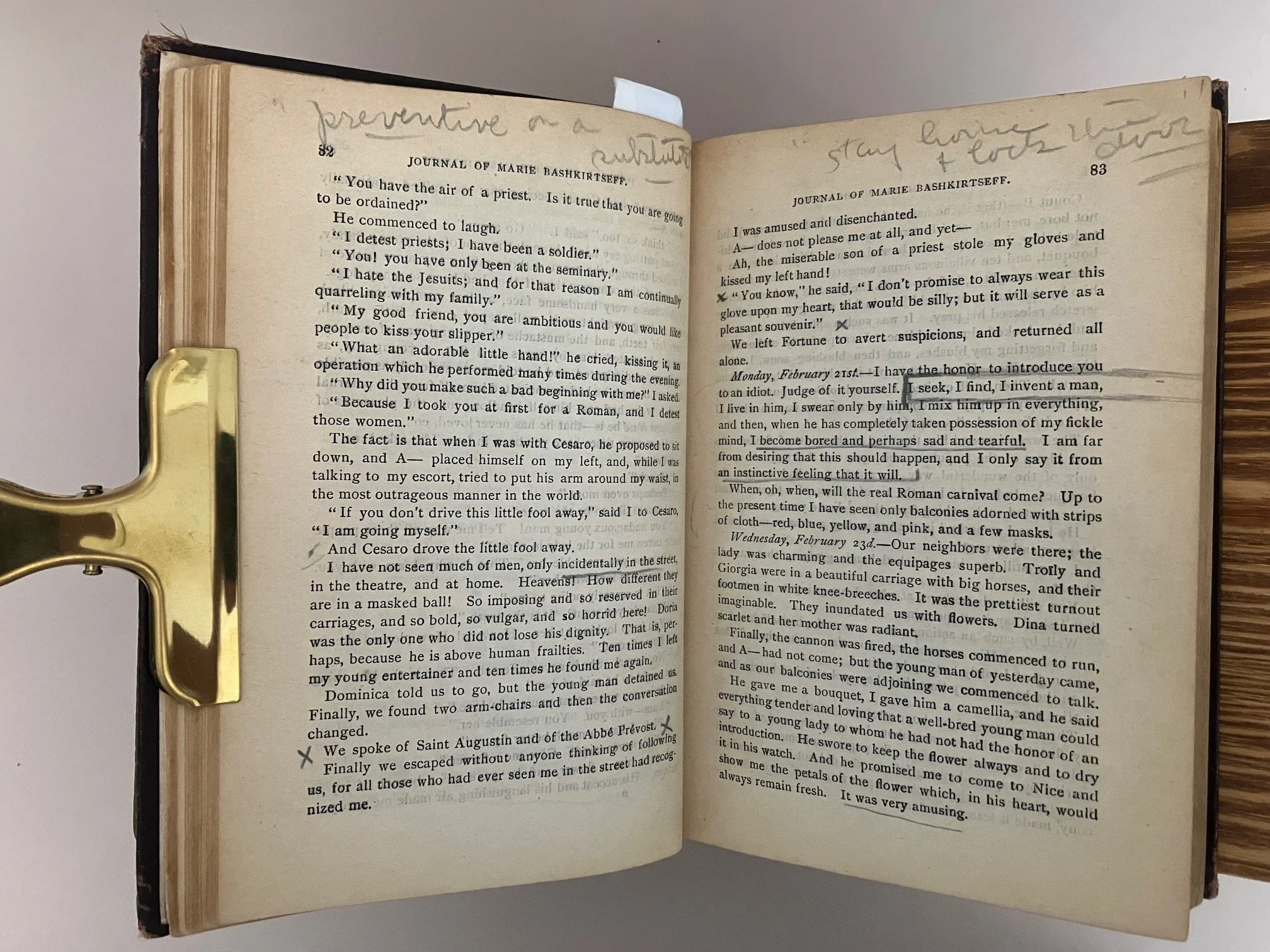
Djuna Barnes' signed and heavily annotated copy of Bashkirtseff's groundbreaking proto-feminist diary, with notes and a sketch related to themes of feminine desire, ambition, and shame in preparation for her own work "appealing to the primitive force in woman"
[LGBTQ+] [People with Disabilities] [Barnes, Djuna] Bashkirtseff, Marie (A.D. Hall, trans.)
Journal of Marie Bashkirtseff (Signed & Annotated by Djuna Barnes)
Chicago & New York: Rand, McNally & Company Publishers, 1913. The Only Complete English Edition. Reprinted from the first partial English translation of 1889. Original publisher's cloth binding with gilt to spine and front board; measuring 185 x 125mm and collating complete including the frontis, with two volumes in one: 461, [1, blank]; 366. Binding shelfworn and shaken; front hinge separating from text block, front endpaper excised, and rear hinge starting; two damaged pages with loss to text. Several ink ownership and gift inscriptions from Paris in 1915 to pastedown and rear of frontis. Pencil ownership signature of Djuna Barnes to rear of frontis, with an original sketch and over 40 extensively annotated pages in pencil by the same with references to preparation for "her book"; given that the other ownership marks suggest that Barnes purchased this secondhand in Paris during her time there after 1921-1939, it seems likely that she was preparing either for Ladies Almanack (1928) or the semi-autobiographical Ryder (1928). A unique association copy, with extensive engagement revealing the inspiration drawn from the exceptional life of an artist with disabilities by a woman who would become one of the most important Modernist lesbian authors.
"Marie Bashkirtseff (1858-1884) was a Ukrainian noblewoman who kept one of the most remarkable diaries in history from age thirteen until her premature death from tuberculosis" at age twenty-five (Diary). Published in 1887 (with English following two years later), it "was only the second diary by a woman published in France to that date"; even so, it was heavily bowdlerized by relatives concerned about their legacies and would not appear complete in English until this present edition (Raoul). A realist painter, some of whose surviving work hangs at the Musee D'Orsay, a number of her paintings would be destroyed by the Nazis for being "degenerate." The diary, which blends incisive observation of the bourgeousie with internal speculation and personal confession, likely also offended such restrictive sensibilities. Bashkirtseff considered herself "the most interesting book of all," and in the diary she wrote: "If I do not die young I hope to live as a great artist; but if I die young, I intend to have my journal, which cannot fail to be interesting, published." Though it was not an initial hit due to its modernist nature, it is structured as a kind of coming of age narrative followed by the disappointments and suffering attached to womanhood (Raoul).
Like Bashkirtseff, Djuna Barnes never reached the heights of fame in her own lifetime but would be remembered for the impact of her writing. She would survive into a later adulthood than Bashkirtseff, but she too would suffer from the chronic illness of alcoholism and its co-morbidities, living later in life "primarily off the kindness of her friend Peggy Guggenheim" who had championed her (Literary Hub). Today, Barnes is celebrated for her ability "to convey, through an unprecedented feminine gaze, the moods, attitudes, and concerns of the lively and the irreverent European avant-garde" and to combine "the explicit homosexuality between women, and the dizzying and incomprehensible structual complexity and style" that was shaping the poetry, visual arts, drama, and music of her moment (Peggy Guggenheim Collection).
It was Barnes' arrival in Paris in 1921 that made her work possible, and the serendipity of finding and reading Bashkirtseff's diary reveals the range of influences swirling around her. Barnes' first notation appears on the margin of the translator's preface, where she clearly finds a connection to the diarist in highlighting a quote: "This is the thought that has always terrified me: To live, to be so filled with ambition, to suffer, to weep, to struggle; and, at the end, oblivion!...as if I had never existed." At page 16, she ticks another similar passage, this one with a more direct reference to the struggles of women: "It is grand to feel that one is admired for something more than one's dress." Such notations appear occasionally and on page 24 we get Barnes' first commentary "convent girls - chorus girls" in response to Bashkirtseff's apparent binary about women's education. Parentheses and ticks increase, with the occasional brief note; but it appears to be something on page 41 which sets her succeeding notes aflame, because here, she expresses concern about passivity in love and victimhood borne out of privilege, writing "me?" X's, heavy underlining, boxed text all focus on how the diarist embraced her own joie de vivre through the arts, creating works that mirrored the sounds in her head and the way she perceived city scapes. By page 61, Barnes leaves a three-quarter sketch of a nude woman, head down, face hidden by hair, with the caption "SHAME?" Even heavier, more text driven annotations follow until page 88, where they peter back out to small ticks and marginal parenthesis. In these spaces, Barnes responds to passages about the solitude of creativity, the madness of loneliness, the yearning for partnership, and the devastating disappointments of men. When Bashkirtseff writes "Come courage, the present is but a passage leading to where all will be well," Barnes writes in a heavy hand "I hope so!" Ultimately, Barnes' notation on page 84 encapsulates what she gets from the diary and hopes to bring into her own "book": "appeals to the primitive force in woman." (437)