Among the most scarce pirated editions of this unrepentant Scandalous Memoir, which was an immediate bestseller
[Scandalous Memoir] [Sex Work] Wilson, Harriette
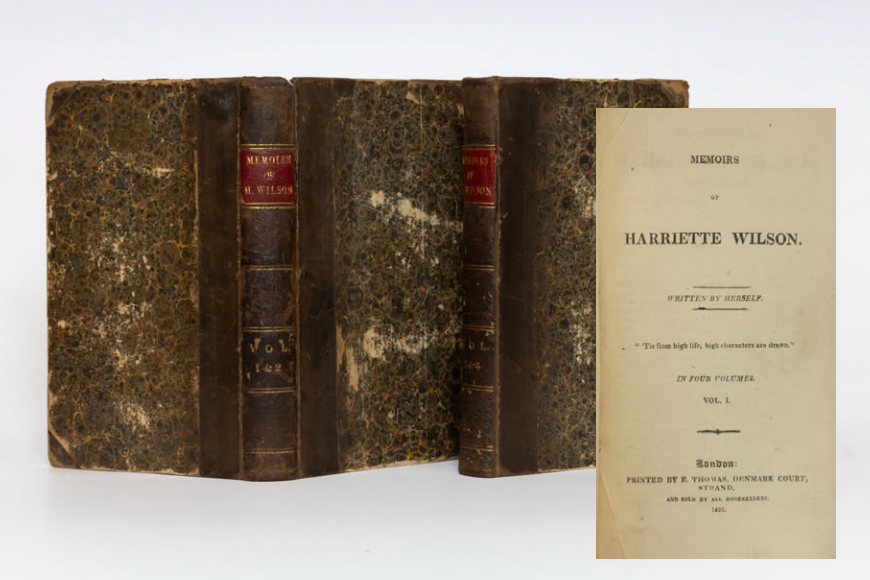
Memoirs of Harriette Wilson. Written by Herself (4 vols. in 2)
London: Printed by E. Thomas, 1825. Pirated edition. Contemporary half calf over marbled boards with morocco and gilt labels to spines. Drab endpapers. Measuring 175 x 105mm and without wrappers included, else collating complete with four volumes bound in two: [2], 184; [2], 3-187, [1]; [2], 3-184; [2], 3-145, [1]. Externally a square, solid copy with some rubbing to extremities and boards. Small bookseller's tickets of J. Sampson to front pastedowns and ownership signature of "Darlington" to all four pastedowns; marginal calculation in pencil to vol. II page 73 regarding an underlined date, and occasional toning to pages, but overall a clean example of the infamous and scarce "Onwhyn" piracy printed by Edward Thomas in parts and sold by J. Onwhyn. "This pirated edition by Thomas was evidently the one Stockdale chose to prosecute in January 1826. The prosecution was brought against J. Onwhyn...the address at which copies were offered for sale on the front wrappers...Onwhyn admitted to having 5,000 copies, but it is sometimes stated that none of these has survived" (Weissman). Several copies of this version do survive, though it is scarce. With the exception of this copy, which appeared at auction in 2022, no other copy of the E. Thomas pirated edition has come to auction. The present edition is also unrecorded in OCLC, with the present being the only example in trade.
With the heft of two generations of Scandalous Memoirists behind her, the courtesan Harriette Wilson promised readers an explosive contribution to the genre. From her opening line she helped revive a movement that was fading: "I shall not say how and why I became, at the age of fifteen, the mistress of the Earl of Craven. Whether it was love, or the severity of my father, or the depravity of my own heart...does not now much signify." Among the last great demi-mondes whose wealth and influence were waining due to new laws and social attitudes regarding sex and sex work, Wilson leveraged her gift for narrative to attract press and create continued relevance. Released in parts between January and April of 1825, the memoir tantilized readers with the promise and denial of gossip, becoming an immediate bestseller. "The Cabinet was said to be engrossed in reading them, jokes were make in Parliament, members of Brooks' held a meeting to discuss action," and booksellers "had to erect barricades outside their premises...to hold back mobs of eager buyers" (Linnane). Not only did Wilson allegedly make £10,000 (approximately £996,000 or $1.25 million today), but she ensured a continuous flow of revenue through reissues and pirated editions for the next twenty years (Linnane). The books, and the pre-publication blackmail of clients who wanted their names redacted from print, helped replace the annuity Wilson had been denied and gave her a living.
As Memoirs recounts, Wilson departed her father's home and embarked on a storied career in sex work, counting among her patrons "the most distinguished men of the day, from the Duke of Wellington to Lord Byron. She held a box at the opera, attended by statesmen, poets, national heroes, aristocrats, and members of the beau monde who hoped to be immortalized by her glance" (Blanch). Written and published as she began showing signs of age that threatened her popularity, Wilson leaned into her personal charm and biting wit to remain in the public eye, unrepentantly reveling in the exposure the life she had built. Casting herself as "spirited and single-minded...ducking and diving through society, making sure, in a world heavily weighed toward men, that she was always on the winning side. Her life story, although controversial, set the early nineteenth century alight by holding up a mirror to the double standards that riddled male and female behavior" (Dangerous Women Project). In this sense, Wilson's was not only a financial triumph, but a tribute to the women of the genre whose feminist writing had laid the groundwork for her own.
Register of Erotic Books 2131 (for the T. Douglas edition only). (380)