
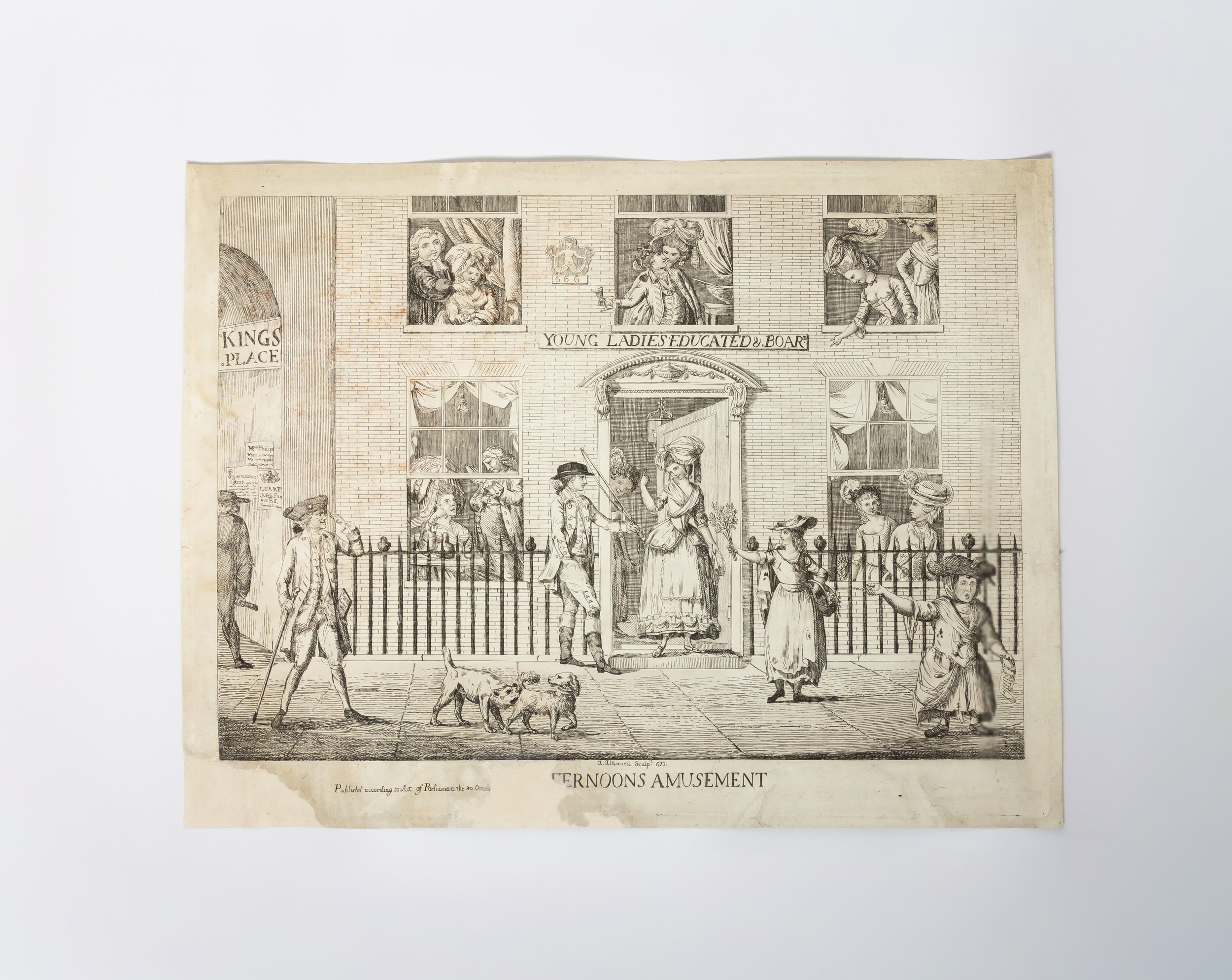
As the famed Charlotte Hayes neared retirement, an engraving of her brothel captured details about its inhabitants, influence, and cultural position in London
[Bawds & Brothels] [Sex Work] [Women-Owned Business] [Hayes, Charlotte] Albanesi, Angelo (engraver)
An Afternoon's Amusement
[London]: [N.P.], 1777. First Edition. Etching measuring 405 x 300mm. Loss and archival restoration to lower margin, affecting title and publication date. Minor browning to corners and margins, but overall clean and crisp. Pencil annotations to lower verso. An incredibly scarce visual account of Charlotte Hayes' famed King's Place brothel, which set a new fashion for the high-end London sex trade, it is not recorded by the British Museum and OCLC locates only two copies at libraries (at Harvard, which is the only example to appear in the auction record, and at the Walpole Library at Yale). The present is the only example in trade.
Before Charlotte Hayes opened her famed brothel at No. 2 King's Place, her mother the bawd Elizabeth Ward had ensured that Hayes' career would be highly visible, public, and successful. "Fresh from Elizabeth Ward's womb, Charlotte was already destined to lie under men for money," and so Ward had "spent Charlotte's childhood scheming how she might best utilize her daughter's virginity for her own gain" (Rubenhold). Having commanded a historically high virgin price at her debut, and having maintained throughout the early blush of her career a reputation for "composure, dignity, and gentility" among other markers of privileged education, "Charlotte had her eye on far wider horizons" (Rubenhold). Rather than aspiring to an annuity and being the kept courtesan of a gentleman, she set out to move "from prostitute to procuress...a marked promotion of rank" (Rubenhold). Inheriting from her mother, consolidating assets with her lover and body guard Dennis O'Kelly, and leveraging her reputation allowed for the creation of a fashionable, French salon style brothel where drinks and entertainment supplemented sexual engagement and the girls "were of the first class" (Nocturnal Revels). Conversation, musical and dancing skill, and other refinements in addition to beauty and erotic prowess made Hayes' King's Place a success. By the time she passed management on to her protegees, Catherine Matthews and then Sarah Dubery, King's Place had become the locale for fashionable and high end erotic pursuits.
The present engraving captures Hayes' brothel at its height -- a point made by the slovenly figure in the lower right corner, who gestures to the brothel with one hand while holding in the other a copy of Harlot's Progress (a series of Hogarth plates from 1732 telling of the rise of Moll Hackabout). The demurely gated, whitewashed front of the brothel bears two signs. The first, "Young Ladies Educated & Boarded," a reference to Hayes' girls' elegance and youth as well as to the interconnection of intellectual and sexual knowledge. The second, a wicked 666, is decorated by another image of doubling; for above the devil's number is a mermaid with a forked tail, suggesting a blending of the masculine and feminine, and an open invitation to fornication. In the window to the left, a mature and more matronly Hayes sits comfortably at table in the company of Dennis O'Kelly. At the door, Catherine Matthews, not yet a bawd, invites a well dressed gentleman with a riding crop to enter while "Black Harriot" Lewis (formerly enslaved, educated, and a neighboring bawd famed for supplying "exotics") prepares to depart after a likely call on Hayes. (An alternative reading could position this younger duo in the door as the past and younger Hayes and O'Kelly, given the illustration's tendency toward doubling). Meanwhile, in the lower right window, someone in cross-dress converses with one of Hayes' girls -- a reminder that queer folks were both employed by and patronized such establishments.
As refined as the ground floor may seem, the street and the upper windows remind the viewer of precisely where they are. Up above, in various states of undress, Hayes' girls entertain men from the upper echelons including religious and military leaders. Down beyond the gate, where a curr bites the hindquarters of a spaniel, two impoverished young women attempt to sell flowers (and perhaps themselves). On the corner to the left, below the sign for King's Place, are a variety of handbills advertising the dildo shop of "Mrs. Philips" (the courtesan Teresia Constantia Muilman Philips), with wares including "preventative lotion" and "Leakes Justifiably famous pill for venereal disease."
A visually rich narrative depiction of Hayes' brothel before her departure two years later, in 1779. Its scarcity institutionally and in trade has prevented significant scholarship and analysis, which could likely uncover an even wider range of references and historical details. (197)