
Inquest documents into the morphine-induced deaths of two sex workers in the rural West raise questions about how race and class shape perceptions of women's value even after death
[Sex Work] [Addiction] County of Deer Lodge.
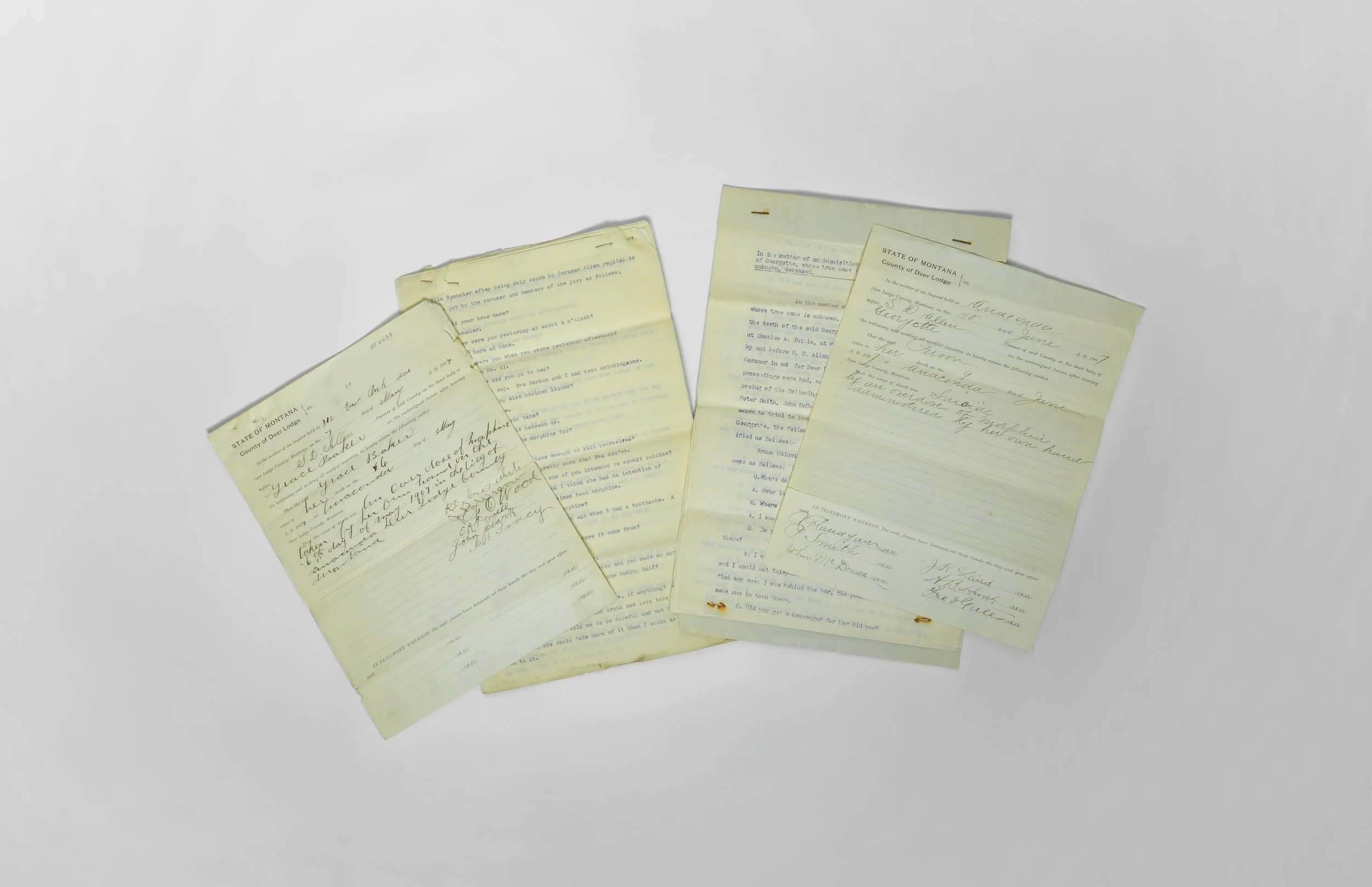
Pair of typescript and partial manuscript inquest documents regarding the overdose deaths of Grace Baker (alias Eva Gordon) and Georgette Doe.
Anaconda, County of Deer Lodge, Montana: 1907. Two sets of inquest and testimony documents regarding the cause of death rulings in May and June 1907 for two sex workers. Each includes the cause-of-death ruling filled out and signed in manuscript by the case's respective jury. The set for Grace Baker (d. May 7, 1907) includes a typed transcript of the inquest in 14 leaves with text to recto only, connected with pins at the header and measuring 330 x 200mm; final sheet with some damage and minor loss of text to center with contents remaining legible, and some staining and ink-docketing to verso of the same. The set for Georgette Doe (d. June 10, 1907) includes a typed transcript of the inquest in 9 leaves with text to recto only, bound at header and measuring 330 x 200mm with an additional leaf at rear with ink docketing to verso; minor staining and holes to margins, with occasional signatures and manuscript notations. Documenting the morphine-induced deaths of two sex workers operating in the same town in the rural West, the present material gives unique insight into the lives and communities which such women inhabited. Through the inquest interviews, we glean details about how and why young women made their way into sex work, the mental and physical health issues they experienced as well as their methods of individual and communal relief, the relationships they built, and the ways that perceptions of race and economic class affected legal rulings about their bodies and value even after death.
The stories of Montana's turn-of-the-century sex workers unfolded a bit differently from those in the Eastern and Southern US. Among the "most wide-open" spaces in the US, Montana drew a range of pioneers seeking new opportunities or fleeing old lives; the state's "designation 'wide-open' also marked it as a place where vice went largely unchecked" (Montana Women's History). Hard physical labor awaited those who came to Montana to work cattle ranches, pan for gold, build railroads, or work in Anaconda's copper mining industry. The trade off was that "sex workers walked the streets, gambling was accepted, and alcohol flowed at all hours of the day...Men could publicize and indulge their vices during broad daylight without concern for arrest" (Headframe). Opportunities were different for women -- especially unmarried women. Few "virtuous" jobs existed. And for women like Grace Baker and Georgette Doe, employment paths constricted in 1907 when a new law banned women from saloons. Tavern owners were forced "to dismantle spaces designated for female drinkers" because "wine-rooms -- the partitioned areas in which some saloon owners permitted women to drink -- were considered incubators of prostitution" (Headframe). The dual outcome was that the legitimate work of serving in a saloon was taken away (increasing the number of women in the sex trade), and that all women including sex workers lost a public, communal, and legal outlet for their stresses. Isolation and illicit drug use often became the alternative.
The inquest documents here present us with tragic outcomes for two such women, though the rulings of their cases differ. In the first case of Grace Baker, we get a deeper picture both because her legal identity was known and disclosed and because her case documents are lengthier. Despite operating under the alias Eva Gordon, friends and colleagues within the trade as well as police officers in her neighborhood knew that she was Grace Baker of "Mizpah, Minnesota" who had come from a good family and "was an organist at the church and had bible class" before coming to Montana. Testimony reveals that her family sometimes sent her letters "that made her feel blue," and that she had a lover in Dillon who would occasionally visit and with whom she may have lived before arriving in her present circumstance. Testimony also shows that Grace existed within a community of women who knew her -- Ella Sponsler (aka Ella Black) with whom she regularly drank at home and with whom she took the morphine in question, Mamie Morris who had seen the girls drinking and went to check on them the next day, Bessie Arnold and Jennie Morse who worked the same street. While these women used their home to create spaces for recreational drinking away from the saloons , they increasingly saw opportunities to soothe their depression with dangerous opiates as well. In the discussion of Grace's life immediately before her end, two questions repeatedly emerge: did she intend to kill herself, and did anyone know or suspect that she had inherited property or money? Despite a history of suicidal ideation and depression, witnesses repeatedly confirmed that Grace simply wanted to relax or get sleep when she used drugs; this, combined with the heavy suggestion that her future was about to change due to potential wealth, seems to shape the jury's ruling of "death by an overdose." This would allow her body to be returned to her family for burial or, at least, ensure a burial in a proper cemetary.
Georgette Doe's case a mere month later is quite different. Noted from the start, this was a woman mysterious to others and her documents list her as "Georgette, whose true name is unknown." With one exception, Josie Schmidt, the witnesses in Georgette's case are all men with whom she had transactional relationships: messengers, tavern owners, bartenders, and waiters. They document that while she drank regularly, she did not appear to use recreational drugs; and among them, one witness notes that in their final encounter she offered to give him her watch and ring as "gifts." While she was noted as in the company of a woman named Zuie on occasion, this person is not interviewed. There seemed to be a question of whether Georgette's first language was English -- a question asked of Josie Schmidt, who clarifies that Georgette could "write in English." Not seen as a dimensional person by authorities or those around her, Georgette is treated as "just" a sex worker. As a result of this flattening, Georgette's case is handled with a level of nonchalance unlike Grace's. Despite the officials on record being the same in both cases, witnesses are questioned only lightly here; and we even discover that Georgette lingered in pain for some time because the tavern workers who heard of her "sickness" couldn't leave the bar, or because the doctor's wife (likely) urged him not to rush to the bed of a sex worker and instead told callers he was unavailable. Unknown name. Unknown citizenship status. Unknown reasons to want to live. Georgette is devalued and dismissed from the beginning, and her case is sealed with the ruling "Suicide by an overdose," which relegated her to an unmarked pauper's grave in unconsecrated ground.
Increasingly gaining credit as "pioneers of a different ilk," sex workers in the Western US were "highly transient and frustratingly anonymous" people who "molded their business practices to survive changes and reforms. As elsewhere, the fines they paid fattened city coffers, and businesses depended on their patronage" (Montana Women's History). Crucial to the local economy, stories like those of Grace and Georgette also need to be understood within a larger context of capitalism and control. "Miners who spent money, time, and energy on public women were less likely to organize against the powerful Anaconda Copper Mining Company. As long as the mines operated, public women served the company by deflecting men's interest" (Montana Women's History). Like the miners themselves, they were disposable cogs in an industrial wheel; and their survival in documents like these help us understand who they were and how they lived. (384)