
Seeking to undermine the spread of white supremacy into the next generation, a Native author calls children of all races to learn and preserve Indigenous stories
[BIPOC] [Native History] Zitkala-Sa | Gertrude Bonnin
Old Indian Legends (Signed)
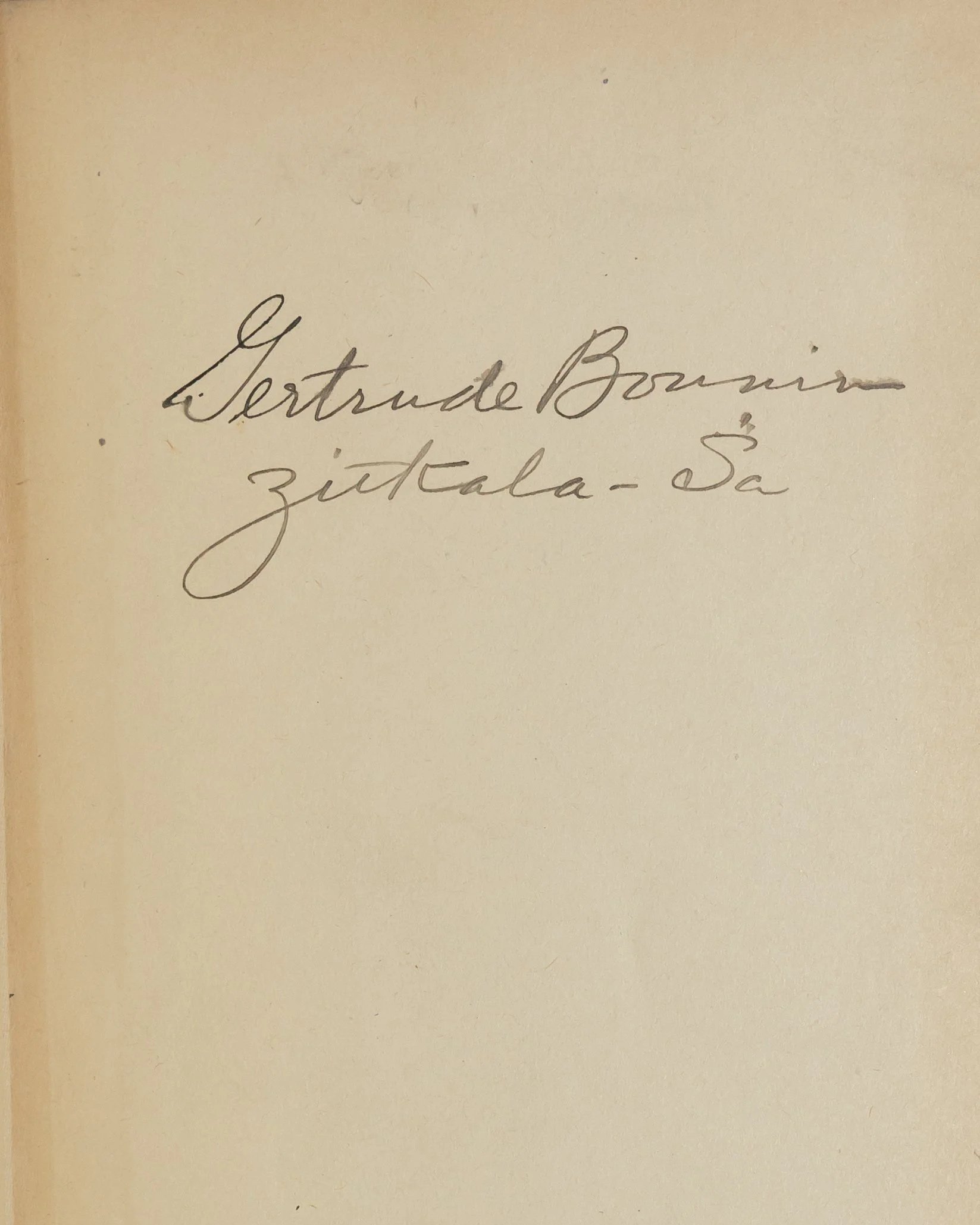
Boston : Ginn & Company, 1901. First Edition. Original publisher's pictorial cloth binding. Measuring 185 x 120mm and collating complete including 14 illustrated leaves: vii, [3], 165, [1]. A Near Fine example with light offsetting to spine and some rippling to cloth along rear joint. Inner hinges strenghtened, with original pastedowns and endpapers retained (toning and offsetting aligned to all four, as well as matching indentations to the paper near the lower gutter at the front). Internally fresh and unmarked. Signed twice on the front endpaper by the author, using both her white and Indigenous names as was her practice: "Gertrude Bonnin. Zitkala-Sa." A cornerstone work in the preservation of Native American oral culture, Old Indian Legends has seven physical copies listed in OCLC. While her later 1921 text American Indian Tales has appeared signed three times at auction, this title has only appeared twice at auction, never signed (in 1987 and 2011).
Sitting between the Indigenous world of her origin and the white American world that sought to assimilate her, Zitkala-Sa (also known as Gertrude Simmons Bonnin) leveraged this difficult position into activism. Her early childhood experiences made her acutely aware of the injustices First Nations people experienced under white supremacy: forced into a Christian boarding school at a young age, she was required to relinquish her Sioux language, dress, and traditions. Clinging to her love of music and storytelling, she excelled at reading and music. Not only did she master the white European methods of piano and violin; she used what she learned to preserve her people's oral culture, eventually raising awareness through performing and publishing the tales that generations behind her might otherwise not hear, and which might force white listeners to see the damaging cultural erasure enacted by their policies. As an adult, Zitkala-Sa would never feel at home again in her native culture. She would never accept white oppression or be accepted by white society. So, she existed in a liminal space, working with the Society of American Indians to advocate for native land rights, funding, infrastructure, and suffrage.
Zitkala-Sa's published work had the dual mission of preserving native tales for native peoples, and of introducing Indigenous stories to English-speaking audiences. Her first standalone work, Old Indian Legends aimed to attract English-speaking juvenile readers of races and backgrounds. In inviting children to read the stories she once "loved so much to hear beside the night fire," she urges them to see how the tales reveal a shared "kinship with the rest of humanity." While the stories are in English here, she calls on her readers to recognize they long existed in other words, and that English has only recently become America's "second tongue." A heroic and groundbreaking act of cultural preservation and literary activism. (369)