
"Nearly forty years of freedom finds us more heavily burdened than ever. Before our eyes we have seen swept away everything that stands for citizenship, and that helps to make a people happy and prosperous..."
[BIPOC] [Black Excellence] [Women] Johnson, W[illiam] Bishop
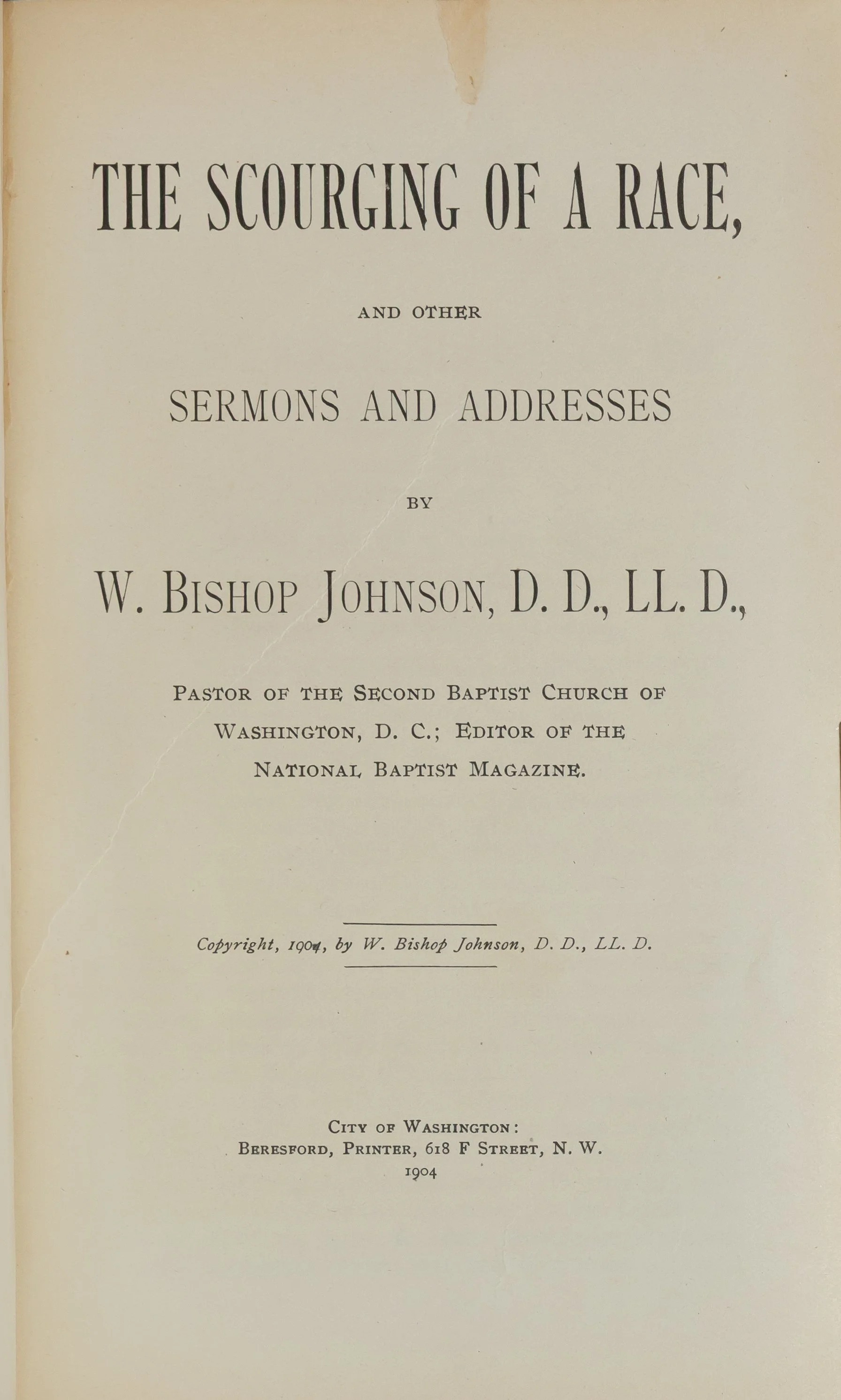
The Scourging of a Race, and Other Sermons and Addresses.
City of Washington: Beresford, 1904. First Edition. Original publisher's cloth with gilt to spine. Measuring 183 x 115mm and collating complete including frontis: viii, 228. A very nearly Fine copy with the slightest wear to extremities and a small scuff to the top margin of the title not affecting any text. Internally fresh and unmarked. While OCLC does not consistently document which holdings are the true first versus one of the many other editions from the same year, at least 25 of the copies are the third through fourteenth editions according to internal notes. The modern auction record has only one appearance (Swann in 2000) and the present is the only example on the market currently.
A collection of twenty-six sermons, essays, and talks by the Reverend Dr. William Bishop Johnson, The Scourging of a Race contains some of the most important political talking points of a major leader in the American Baptist National Convention. It is a call to the Black community to remember the struggles and discrimination of the recent past, to use that history as a motivator in pursuing a better future, and to give proper credit to those -- notably members of the military and Black women -- who have made the greatest sacrifices. He even dedicates the text to his own mother: "To the memory of my dear mother Matilda Johnson, whose Christian character and motherly instruction have been an inspiration and a benediction to me."
Johnson opens the text by calling on his Black readers to question their current political and economic circumstances, setting aside passivity for action. "Nearly forty years of freedom finds us more heavily burdened than ever. Before our eyes we have seen swept away everything that stands for citizenship, and that helps to make a people happy and prosperous. Now why should the Negro be scourged so unmercifully after all these years of sacrifice and service, in a land he has helped to enrich, and which he still helps to beautify and maintain?" The generational investments made by Black Americans -- first under violent duress and then out of their own will -- animates much of Johnson's work. He calls upon his audience not to give in to despair. Equally he urges them to relinquish passivity: "What we call the patient, humble Negro will have gone." In a move that seems to predict the rise of community groups such as the Black Panthers, he encourages his brethren if need be to create "a fort with Winchester and Gatling guns to keep out the wildcats and crows."
As much as Johnson focuses on Black men's place in American society, he also heavily prioritizes women and promotes their roles. "There are two shrines at which enlightened men worship -- God and woman," he asserts. As an ideal, woman is "as beautiful as she is strong, as tender as she is sensible." Neither weak nor passive, Black women have endured and have helped ensure the endurance of the race through enslavement. "God honored womanhood in the birth of Christ. She was party to the fall and now becomes a party to salvation."
Calling upon Black Americans to value themselves, to shake off shame and prejudice imposed by white supremacy, Johnson urges his community to pull together and act in ways that can address those wants that can only be gained by demand: educational access and literacy, and upward mobility born of economic opportunity. (333)