
A request for County burial payment uncovers the widespread familial bonds among enslaved and free, Black and white, in a plantation-centered town
[BIPOC] [Free and Enslaved Black Families] [Interracial Identities] [Community Care]
State of Maryland, St. Mary's County to James L. Biscoe
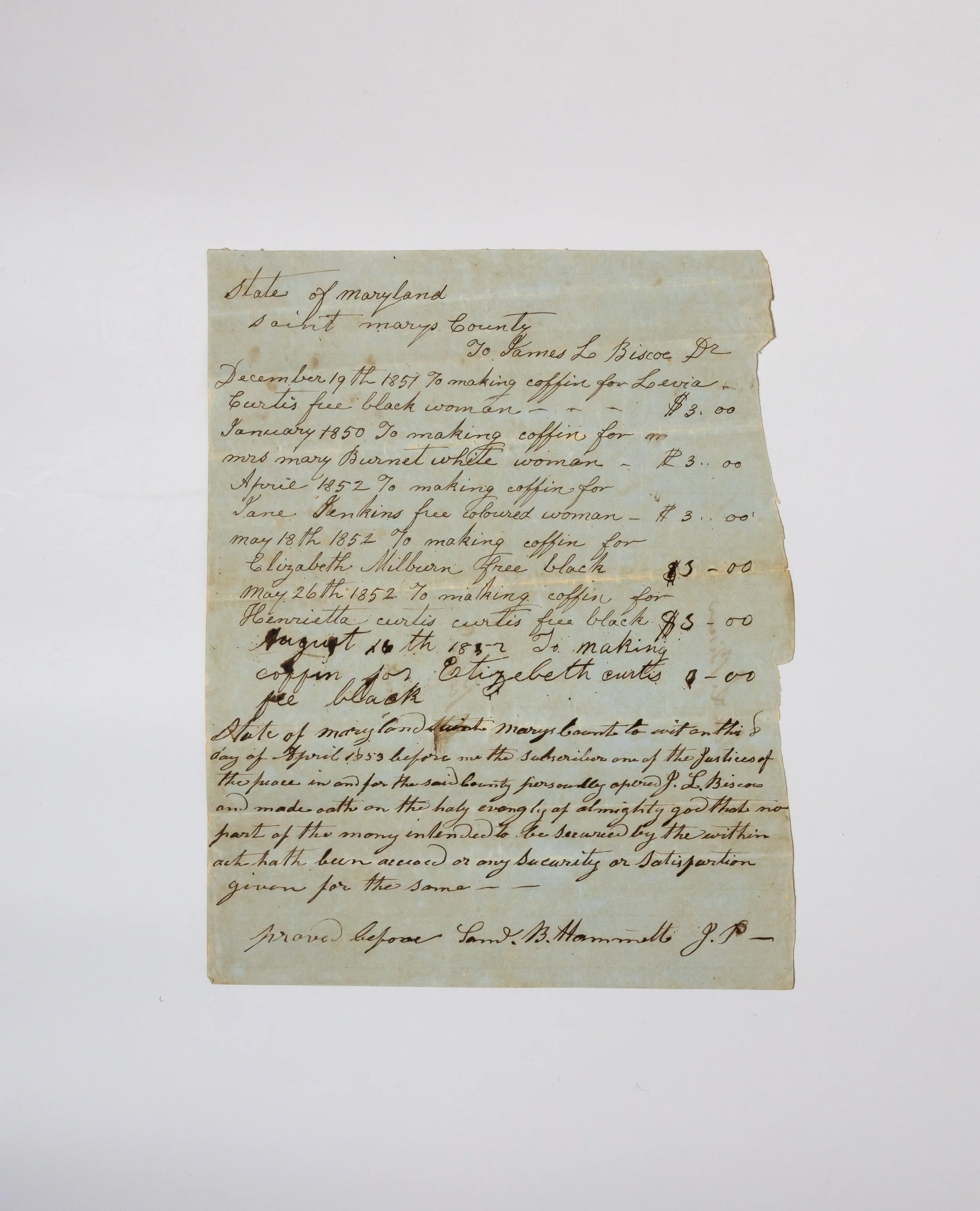
St. Mary's County, MD: 8 April 1853. Single sheet measuring 225 x 185mm with manuscript text in a single hand to recto and docketing to verso. Right margin unevenly torn not affecting text. Some fading and wear along uneven horizontal foldlines. Fading and staining to verso. A unique manuscript from a small plantation-centered portion of Maryland, documenting coffin-making for three Black women, one Black infant, and one white woman whose lives ended between 1850-1852. More than a record of the economics of burial, the document also preserves the complex family ties that existed among enslaved and free Black Americans, with white biological family members, and with social categories of race; and it raises important questions about how members of those families defined their relationships and communities.
On the 8th of April, 1853, St. Mary's County Justice of the Peace Samuel B[iscoe] Hammett supported payment of the receipt submitted by James L. Biscoe, listed in the 1850 Census as a carpenter, by confirming that "no part of the mony[sic] intended to be Secured by the within actor hath been accrued[?] or any Security of Satisfaction given for the same." The receipt in question was for six coffins, with five priced at $3.00 each and one, for what the Census shows as an infant, at $1.00 between, 1850-1852. All of the deceased were female, and all but one were Black: "for Levia Curtis, free Black woman...for Mrs. Mary Burnet white woman...for Jane Jenkins free coloured woman...for Elizabeth Milburn free Black woman...for Henrietta Curtis, free Black...for Elizabeth Curtis, free Black." Just as the tradesman and county official share the name Biscoe tying them together, three of the deceased are all tied by the name Curtis. What Census records, death records, enslavement schedules, and other historical documents show is that in some way, nearly party was related.
Terry Peterkin Brock's 2014 dissertation All of Us Would Walk Together: The Transition from Slavery to Freedom at St. Mary's City, Maryland uses archaelogical surveys of the area to, in part, uncover the historical lived experiences of enslaved members of the Biscoe, Curtis, and Milburn families on several plantations owned by major enslavers John and Susannah Brome. "Brome built his plantation into one of the largest in Southern Maryland, both in acreage and slaveholdings...and was home to over 60 enslaved African Americans" (Brock). In examining the physical evidence regarding "how Brome managed his plantation during and after slavery" his research also uncovers how the Black peoples there "used, reused, modified, and changed the plantation landscape to survive their bondage and define their freedom" following Emancipation (Brock). While the dissertation is most interested in the artifacts and architectures of the space in which Black peoples and white enslavers coexisted, its analysis also reveals the kinds of abuses enacted on Black bodies -- whether through sexual abuse and pregnancy, corporal punishment, or confined movement beyond the plantation. Brock acknowledges a number of members of these Black families who were sold or self-emancipated. However, in and near the plantation, even through 1870, large concentrations of these families remained. As Brock notes, this was borne of the psychological and emotional manipulation designed by Brome. Unlike those who broke up relationships through cruel sales, Brome had instead deployed a unique "strategy of building families on the plantation," aiming to encourage bonds that made communal punishment more effective and ensured a reduction in escape attempts. Even a local presence of freed family members economically benefitted his businesses, when these individuals opted to remain near and maintain ties. What isn't clear is just how many Curtises, Biscoes, Milburns, and others existed outside the plantation, living free -- whether legally, by being owned by free family members, or by passing due to their mixed race heritage -- and to what extent they defined their families biologically or through bonds of experience and proximity.
Of the community members listed on the present receipt, James L. Biscoe and Samuel Biscoe Hammett are not listed as Black in the 1850 Census, despite having enslaved relatives on the Brome plantations. What's more, they hold positions of trust or authority -- Samuel in particular -- that seem unlikely for any but white or white passing men. Meanwhile, Samuel ensures that James is paid $16 (approximately $670 today) for providing coffins for a predominantly Black group of women linked either biologically or through a history of enslavement to the same families. The question lingers as to whether this collaboration was one of two white men profiting off tragedy, or if it was one of community care and ensuring the dignity of their own Black families after loss.
Records on members of the Curtis family, though scattered, offer us insight into the wide family network and range of experiences of its members, which "in many cases had large nuclear families with a number of children" as well as "elderly [members] likely unable to make long journeys or risk potential unknown conditions at the journey's end" (Brock). The only document we could find for Levia Curtis (b. 1819), for example, was in the 1850 Census Slave Schedule, which lists her as a "mulatto"; two years later, this receipt lists her as free. Henrietta Curtis, listed as 50 years old in the 1850 Census, was married; and her death records show the cause as "heartstrain" after one day of illness. Elizabeth Curtis, the youngest listed, would have been two and a half years old at the time of death; the same census shows her living with a large group of Curtis family members and serving the 65 year old, white husband and wife Somervilles. While our research has been unable to confirm Jane Jenkins or Mary Burnet as members of these other families, further research could be done into potential connections. As many enslaved and formerly enslaved Black Americans altered their last names through force or choice, a link is likely. Census records show that Jane (b. 1775) was the oldest of the deceased, lived with family and was noted as illiterate, making it likely that she lived at least part of her life enslaved; but we have been unable so far to locate Mary Burnet.
The grouping of family members' burial arrangements across several years suggests that James was selected (or opted) to oversee coffin construction because of biological or community connections. "Economically and socially [during the 19th century] the act of dying was not a simple transition but a consumption event, a service industry, and a site of social obligation" (Brewminate). Not only was his role as a local carpenter related to undertaking ("early coffins were manufactured by locak furniture and cabinet makers, who were often also undertakers"), but the prices for his service were fair and even below the typical cost (with "a simple pine coffin in 1840 costing between $2 and $3," and no additional amount on this receipt accounting for inflation) (National Museum of Civil War Medicine). His appeal to the County for payment, accompanied by Samuel's approval, reveals either these women and children were part of the working poor who lacked funds for burial, or that these two men recognized "how much that cost mattered in everyday life" and opted to relieve the families from its expense given that "even such modest outlay could represent several days' wages" (Brewminate).
A unique document covering a scarce topic in the historical record, with wide and broad research potential, and deserving of further study. (355)