
A critique of educational and economic systems that leave young women vulnerable to abuse, and an acknowledgement of the power of female friendship
[Sensational Novel] [Feminist Literature] Riccoboni, Marie Jeanne.
The History of Miss Jenny Salisbury...Translated from the French of the Celebrated Madame Riccoboni (in 2 vols.)
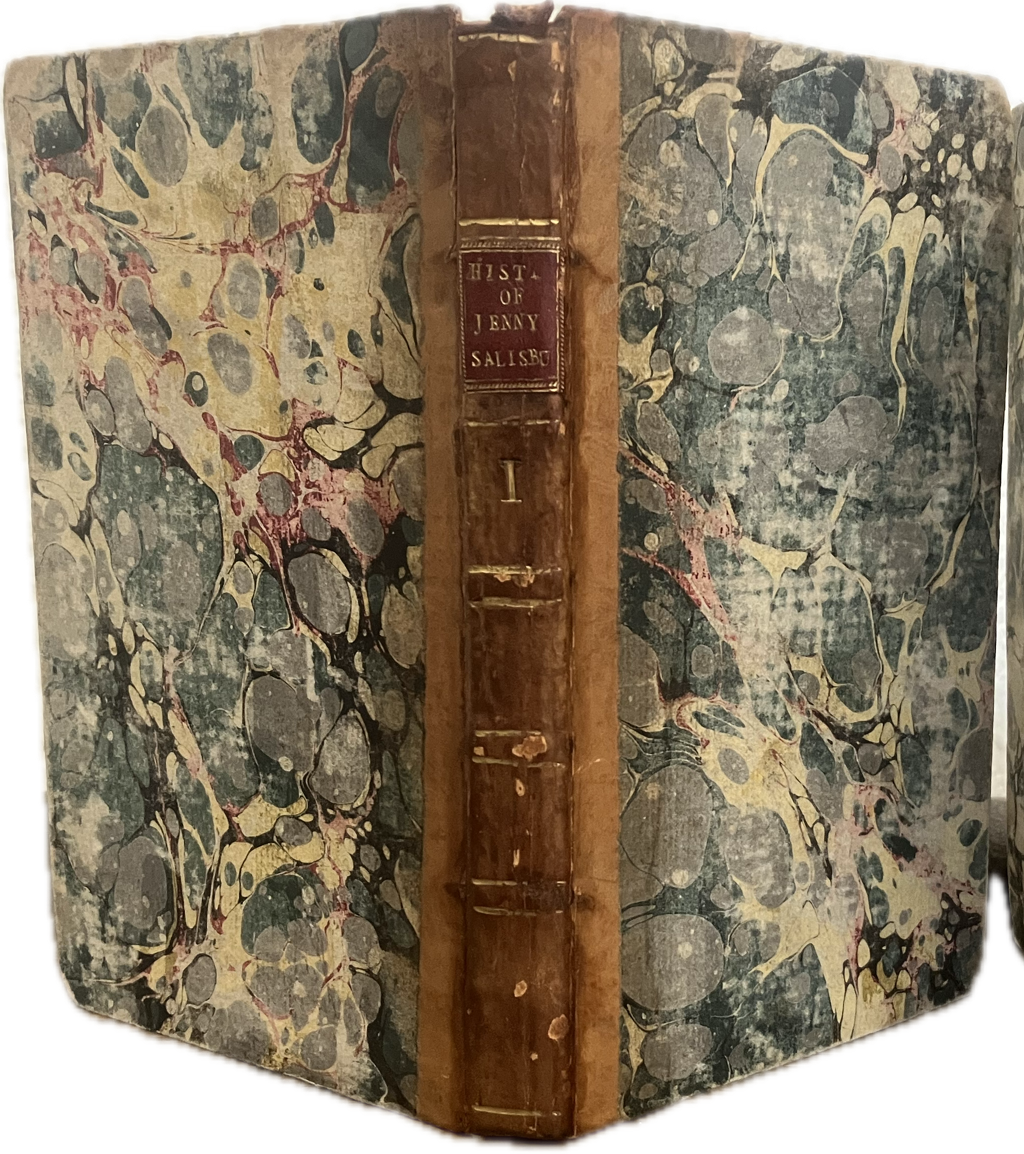
London: T. Becket and P.A. De Hondt, 1764. First Edition in English. Contemporary quarter calf over marbled boards with gilt and morocco to spines. Measuring 168 x 100mm and collating complete including half titles: [4], 219, [1]; [4], 243, [7, license and adverts]. Gentle rubbing to boards, with some loss to crown and cracking to rear joint of volume II. Occasional toning to leaves but generally clean. Marginal loss from rough opening to bottom of pages 145-146 of volume II with no text loss; faint worming to outer margins of title through page 8 and to upper corners of pages 51-56 of volume II with no text affected. In all, a pleasing, unsophisticated set of this ambitious epistolary marriage novel, which ESTC reports at 7 US libraries; its last appearance at auction was over a century ago, in 1899. The present is the only example in trade.
Involved in the production and marketing of her novels, Marie Jeanne Riccoboni is considered one of the first "modern" women authors, with publications emphasizing "women's issues and experience, critiques of social and sexual inequities, and a demand for justice for the female sex" (Winn & Larsen). In her own time, she was an influential figure and a woman known for her wide range of life experience. "An actress who turned to writing in mid-career...she depended on her works for her income and she wrote not to fill her leisure but to sell" (Winn & Larsen). The translation and sale of her works abroad was a mark of success, and the present History of Miss Jenny Salisbury was released in London the same year as the original first edition in Paris (Public Advertiser).
An epistolary marriage novel, The History of Miss Jenny Salisbury spoke to the serious concerns of women on either side of the channel while wrapping its narrative in appealing sensational tropes. "Disinherited by a cruel grandfather, tricked into a sham marriage by a bigamist with a double identity, denied a true marriage because her would-be husband is killed by her first husband," Jenny Salisbury seems like the perfect tragic heroine (Sartori & Zimmerman). Yet each step of the novel, readers are confronted with the truth that Jenny is a woman with limited options due to the systems surrounding her. She should be prepared for adulthood, given that she is "a young woman who attended a boarding school," yet she acknowledges "that she learned 'accomplishments' but not the 'useful principles which enable us to enjoy good fortune in moderation'" (Breashears). Not only has schooling made her susceptible to the world of men, so too has her very birth -- illegitimate, and an orphan, she is more likely to fall prey to abuse than to acquire a safe and stable marriage. Presenting the challenges young women faced when literature taught them to dream of romance but reality made them marriage market commodities, the novel also took to task the rise of allegedly progressive education systems for women that failed to prepare them for the dangers of men. In Jenny, it also celebrates the goodness of love born through female friendship, as she ultimately sacrifices her own happiness to secure such longterm safety and marital joy for her dearest friend.
ESTC T133748. Women's Print History Project 5070 (for the subsequent Dublin edition printed by Sarah Cotter). (255)